When people get to the point of picking a wood for their floors, the conversation usually starts with white oak vs red oak, and then someone asks whether hickory or maple would hold up better. All four are domestic hardwoods we install in Triangle homes, and any of them can make a good floor. They differ in color, in how they wear and take stain, and in what they cost to install and to refinish later, so the right pick depends on the house and on how hard your household is on floors.
The Four Species Side By Side
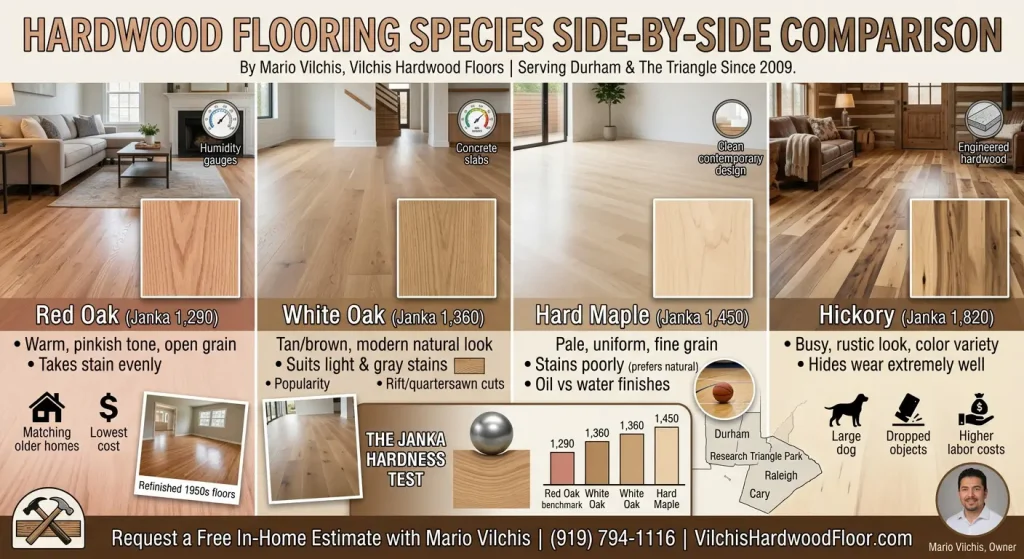
| Species | Janka hardness (lbf) | Look | Takes stain |
|---|---|---|---|
| Red oak | 1,290 | Warm, with a slight pink or red tone and a strong open grain | Evenly, in almost any color |
| White oak | 1,360 | Tan to light brown, tighter grain, less pink | Well, especially natural, light, and gray tones |
| Hard maple | 1,450 | Pale and creamy with a fine, quiet grain | Poorly. Darker stains tend to blotch |
| Hickory | 1,820 | Big swings from blond to dark brown in the same room | Unevenly, so most people leave it natural |
The hardness numbers come from the Janka test, which measures how much force it takes to press a steel ball halfway into the wood. They’re the standard published values, like the ones in this Janka hardness chart from Missouri University of Science and Technology. Red oak is the usual benchmark. White oak is a little harder, maple harder still, and hickory is in a different league.
What Janka Hardness Does And Doesn’t Tell You
A higher number means the wood resists dents better. Dropped pans, high heels, and chair legs dent hickory less than they dent red oak.
Hardness does less for scratches, because most scratches on a finished floor are in the finish, not the wood. A hard species under a soft or glossy finish can still look scratched up within a year. Our post on hardwood versus LVP with kids and dogs goes into what a big dog does to a satin oak floor. What hides wear best is a busy grain, a color in the middle range, and a low-sheen finish, with hardness helping on top of that.
Red Oak
Red oak is in a lot of Triangle houses, especially older ones. When we pull up carpet in a 1950s Durham ranch or refinish a floor in an older Raleigh neighborhood, it’s usually red oak or white oak. If you’re adding onto a house or patching into an existing floor, matching what’s already there almost always wins, and our post on matching new hardwood to old floors explains why.
It’s also the least expensive of the four and the easiest to install and sand. It takes stain evenly, from a natural finish to a dark walnut color, and its open grain hides small dents and scratches well. The tradeoff is that pink undertone. Under a gray or very light stain, red oak can look a little rosy, which is why people chasing a modern natural look usually end up at white oak.
White Oak
White oak is the most-requested wood we install right now. It’s browner and less pink than red oak, with a slightly tighter grain, and it suits the natural and gray-brown colors a lot of people want.
Its pores are mostly plugged, which is why white oak has been used for barrels for so long, and it handles a spill a little better than red oak does. Neither one should be left sitting in water, though. White oak also comes in rift-sawn and quarter-sawn cuts, which have a straighter grain pattern and move less with humidity than a standard cut. Those cost more, but they’re a good choice for wide planks. Standard white oak costs a bit more than red oak to buy, and sanding and refinishing it later costs about the same.
Hickory
Hickory is the hardest of the four by a wide margin, and its color is all over the place. One board can run from almost white to dark brown, and the room ends up with a rustic, busy look. Some people love it, and some find it too much for a whole house.
That busy look is also why hickory is good at hiding wear. Dents, scratches, dog hair, and red clay dust disappear into it in a way they don’t on a calm maple floor. If you’ve got big dogs and want real wood, hickory is worth a serious look.
The downsides come from the same hardness. Hickory is tougher to cut, nail, and sand, so labor costs more on the way in and at every refinish. It doesn’t take stain evenly, so we usually leave it natural or close to it.
Maple
Hard maple is the wood on basketball courts and gym floors. It’s pale and smooth, and the grain is so fine that the floor reads almost as one surface. In a modern house with a light, clean look, it’s beautiful.
It’s also the pickiest of the four. Maple’s tight grain doesn’t take stain evenly, and darker colors tend to blotch, so most maple floors stay natural. That pale, even surface shows dirt and scratches more than a busier grain does. Under an oil-based finish, maple turns more yellow over time, so a water-based finish is the usual choice if you want it to stay light. And refinishing it takes care, because as we said in our post on what it costs to refinish hardwood in Durham, maple shows lap marks if it’s sanded wrong.
What The Triangle Adds To The Decision
Our humidity is the part people underestimate. Summers here are muggy and winters are dry once the heat comes on, and every one of these woods swells and shrinks with that cycle. Letting the wood acclimate in your house before it’s installed, and keeping your indoor humidity steady afterward, matter as much as which species you pick. Our post on how humidity affects hardwood floors covers what to expect each season.
The other big factor is what’s under the floor. A lot of newer Triangle houses sit on a concrete slab, and solid hardwood doesn’t go straight onto a slab. All four species come as engineered hardwood, with a real wood top layer over a plywood core, and that’s usually the answer on concrete. Our post on solid versus engineered hardwood explains the tradeoffs.
Finally, think about how it’ll be finished. Unfinished boards that are sanded and finished in your house give you full control over the color and a flatter surface. Prefinished boards come with the color already on and go in faster. Our post on site-finished versus prefinished floors goes through when each makes sense.
Which One We’d Pick
These are the starting points we usually suggest on an estimate, before we’ve seen anything that changes the answer:
- Matching or adding onto an older house: whatever is already there, which is usually red or white oak.
- Tightest budget: red oak.
- Light, natural, or gray-brown modern look: white oak, in rift and quarter-sawn if the budget allows.
- Big dogs, busy household, and you want the floor to hide wear: hickory.
- Pale, clean, contemporary look in a house that’s easy on floors: maple, left natural.
What It Costs
Red oak is the cheapest to buy and install. White oak costs a bit more, and maple and hickory climb from there, both for the wood and for the extra labor they take. Our 2026 guide to hardwood installation costs in Durham has the numbers, and every quote we write lists material and labor separately so you can compare species side by side.
Seeing Them In Your Own Light
Samples look different in a showroom than they do in your living room at four in the afternoon. On a free in-home estimate, I’ll bring samples, look at the subfloor or slab, and talk through how you use the space. We’re a family-run Durham flooring business that has been installing and refinishing floors across the Triangle since 2009. You get a written, fixed quote by email, usually within a day or two, and you can see more of our work on our hardwood flooring page.
Vilchis Hardwood Floors
237 Obie Dr, Durham, NC 27713
(919) 794-1116
[email protected]
Monday through Friday, 9:00 AM to 5:00 PM
Serving Durham, Raleigh, Cary, Chapel Hill, Carrboro, Hillsborough, Apex, Morrisville, Garner, and Wake Forest.
Request a free in-home estimate
Frequently Asked Questions
Is White Oak Better Than Red Oak?
It depends on what you want. White oak is slightly harder and handles spills a little better, and it suits light and gray-brown colors. Red oak costs less and takes stain evenly, which makes it the easier match for a lot of older Triangle floors.
What Is The Most Durable Hardwood Floor?
Of these four, hickory is the hardest and the best at hiding wear. How durable a floor feels day to day also depends on the finish and how you care for it.
Can You Stain Maple Or Hickory Dark?
You can, but both take stain unevenly. Maple tends to blotch and hickory’s color swings get exaggerated. We’ll always do sample boards first, and most people end up keeping both species natural.
Which Hardwood Is Best With Dogs?
Hickory, or a busy-grained oak in a middle color with a low-sheen finish. Keep the dog’s nails trimmed either way.
Mario Vilchis runs Vilchis Hardwood Floors out of 237 Obie Dr in Durham. He’s been installing and refinishing wood floors in the Triangle since 2009 and shows up to every estimate himself. Reach the shop at (919) 794-1116.