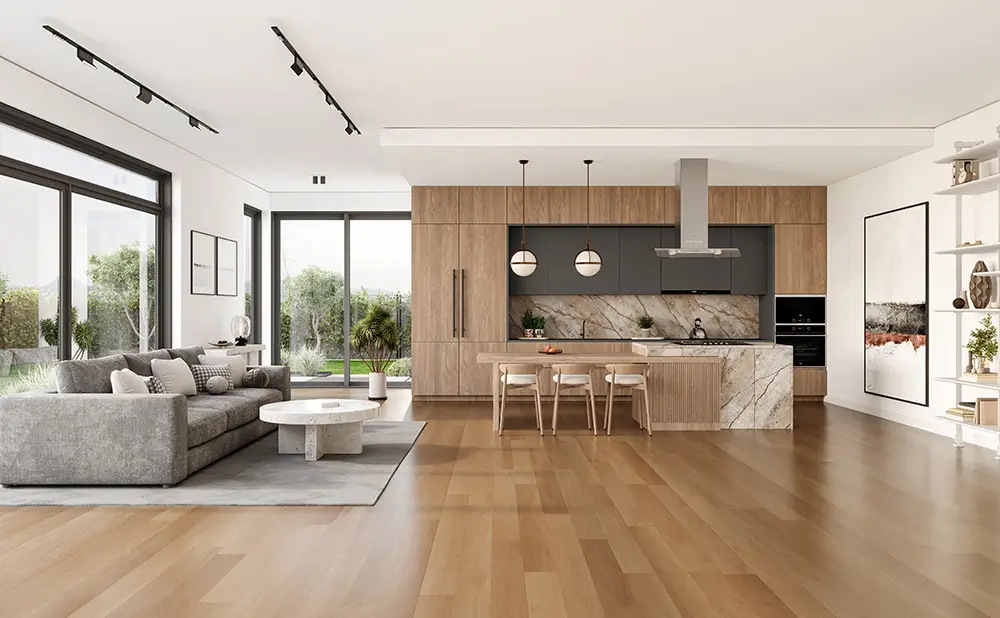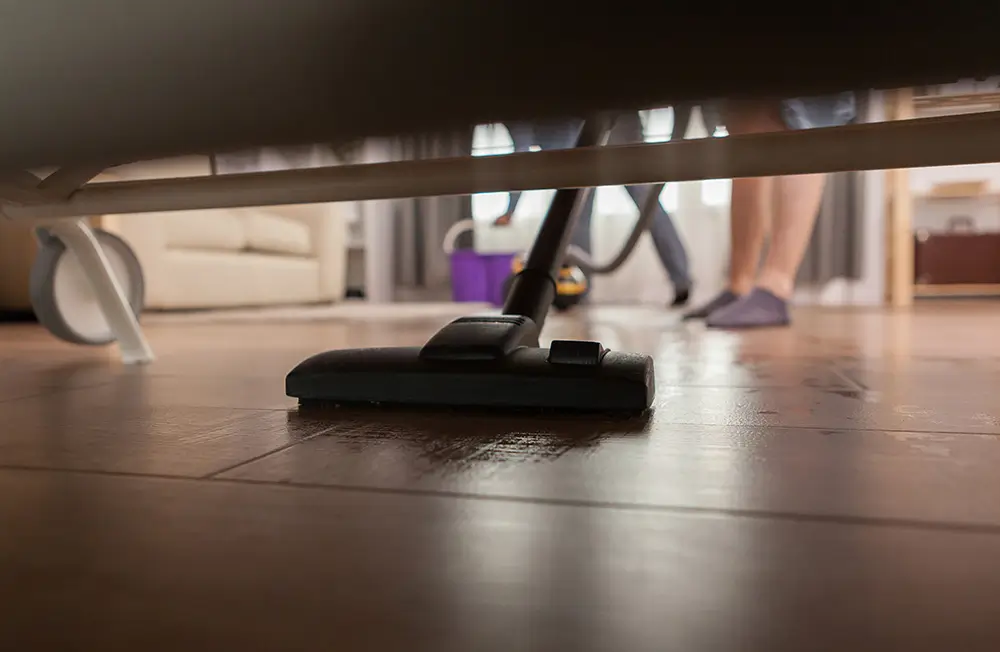

Matte hides the most wear, satin sits in the middle, and semi-gloss looks great for about a week before every footprint starts to show. That’s the short version of what we see on refinished floors around Durham. The longer version comes down to light, and mostly to the light coming through your windows in the afternoon.
Sheen is how much light the top coat of finish bounces back at you. A sample in a store is lit from the ceiling, and under that light every sheen looks fine. Your living room is lit from the side by windows, and side light is what picks out scratches, dust and dog hair. It’s the same reason I tell people not to pick a stain color off a phone screen: you have to see it on your floor, in your light.
What sheen means on a finish label
Finish makers measure sheen with a gloss meter. It shines light at the surface from a 60-degree angle and reads how much comes back, on a scale that starts near zero for a dead-flat surface and goes past 80 for a mirror shine. Roughly, the four names land here:
| Sheen | Typical gloss reading | How it reads on the floor |
|---|---|---|
| Matte (and extra matte) | about 5 to 25 | Close to bare wood, very little reflection |
| Satin | about 25 to 45 | A low glow; looks finished without looking wet |
| Semi-gloss | about 50 to 70 | Clearly shiny; reflects windows and lamps |
| Gloss | 75 and up | Mirror-like, the gym-floor look |
Every brand draws those lines a little differently, so one company’s satin can look like another company’s semi-gloss. When you compare quotes, ask which product and which sheen the refinisher plans to use, and look at that exact product. The National Wood Flooring Association’s guide to finishes uses the same four steps, from gloss down to matte, and says low-gloss finishes are in high demand.
Only the last coat decides the sheen. The coats underneath can be anything, and on dark stain a lot of refinishers build the lower coats in gloss, because several coats of matte stacked up can look a little cloudy.
Sheen also has very little to do with how tough the floor is. Durability comes from the product line and the number of coats, and that’s where most of the price difference is too. We go through how the finish type and number of coats change the price in our Durham cost guide.
How window light changes what you see
A scratch is a tiny groove, and it scatters light in every direction. On a shiny floor the surface around it acts like a mirror, so the groove shows up as a pale line. On a matte floor the whole surface is already scattering light, so the scratch blends in. Dust and dog hair behave the same way. On a glossy floor they sit on top like crumbs on a glass table.
Which way you’re looking matters as much as the sheen. Stand with a sunny window in front of you and look across the floor toward it, and you’re seeing the worst case: glare on anything shiny, with every paw print lit up. Turn around so the window is behind you and the same floor looks darker and richer, and the gap between satin and semi-gloss nearly disappears. Most rooms get seen both ways every day.
The season matters too. Durham sits at about 36 degrees north. At noon in late December the sun is only about 30 degrees above the horizon, while in late June it’s up around 77. Winter light comes in low and reaches deep into the room, so it rakes across the floor for more of the day. A satin floor that looked soft when you picked it in July can show a lot more in January.
Then there’s the yellow pine pollen every spring. Through late March and April it blows in every time the door opens, and on a dark semi-gloss floor by the entry you’ll see it within a day. Red clay dust off shoes does the same thing all year.
After dark, recessed LED lights put a bright spot on a glossy floor under each fixture. A matte floor spreads that light out.
Matte
Matte is the closest a finished floor gets to bare wood. It’s what most people mean when they ask for a natural or modern look, and it’s where white oak and unstained red oak look their best.
It hides fine scratches, light dust and a bit of dog hair. It also hides unevenness, which matters in older Durham houses where the floors have moved over the decades. On the original heart pine in Trinity Park and Old North Durham, and on plenty of 1920s oak, a glossy finish draws a bright line along every board edge and low spot. Matte lets the floor look flat even when it isn’t quite.
The weak spot is grease. Bare feet, socks and kitchen splatter leave oils that look shinier than the matte around them. After a few years, the paths you walk most can polish up and look slightly shinier than the edges of the room. The wrong cleaner shows up faster on matte too, as hazy patches, so it’s worth reading up on cleaning hardwood without dulling the finish.
People often ask whether matte wears out faster. A matte from a commercial-grade line will outlast a satin from a bargain line, and within the same product, matte and satin wear about the same.
Satin
Satin has a soft glow. It looks finished without looking wet, and it suits stained floors and traditional houses. It’s been the default pick for years, and if you’re torn between two sheens, satin is usually the one you won’t regret.
It hides normal wear in most light. Where it starts to show is low winter sun on a dark stain, and dog nail tracks are the usual example. Our Raleigh comparison of LVP and hardwood describes what a big dog does to a satin oak floor in a few months. With a big dog and a dark floor, I’d lean toward matte.
Semi-gloss and gloss
Semi-gloss gives a floor depth. The grain stands out, the color looks richer, and on the day we finish it, it’s the best-looking floor in the house. It also shows dust, footprints, paw prints and every scratch as soon as side light hits it, and on an older floor it makes the boards look wavier than they are.
Repairs are harder to hide on a shiny floor. Fixing scratches in a finished floor gets trickier because the touch-up has to match the shine around it, or it shows up as a dull spot.
Full gloss takes all of that further, and it’s rare in homes now. Semi-gloss can make sense in a formal dining room or a front room that gets little traffic and no pets. Some people want the shine and don’t mind dusting more often, which is a fine choice when you know what you’re signing up for.
How stain color and sheen work together
Color and sheen add up. A dark floor already shows dust and lint because of the contrast, and a scratch in dark stain shows as a light line. Put semi-gloss on top and you’ve combined the two things that show the most. A mid-tone or natural floor in matte is the other end of the scale: scratches have little contrast, and the surface doesn’t reflect them.
| Combination | How much everyday wear shows |
|---|---|
| Dark stain, semi-gloss | The most. Dust, pollen, paw prints and scratches all show. |
| Dark stain, matte | Dust still shows on the dark color; scratches much less. |
| Mid-tone stain, satin | Hides most daily wear in most light. |
| Natural or light color, matte | The least. Scratches barely show. |
The wood species plays a part. Red oak’s open grain breaks up reflections and hides more than maple, whose smooth, tight surface shows everything under a shiny finish. Our species guide covers how red oak, white oak, hickory and maple hide wear.
Which sheen we’d put in which room
- Kitchen and the path in from the garage: matte or satin, with three coats of finish. These spots take the most grit and the most spills.
- Living rooms with big south- or west-facing windows: matte. That includes older homes in Watts-Hillandale and Trinity Park with tall windows, and newer South Durham houses with a wall of glass across the back.
- Bedrooms: anything works. The traffic is low and the light is mostly soft.
- Stairs: matte or satin. You see each tread from a foot or two away as you climb, so every scuff on a shiny tread is right in front of you.
- Formal dining room: the one room where semi-gloss holds up, if you want it.
Rooms that open into each other should get the same sheen, though. A sheen change shows as a line at the doorway, and an open floor plan has no doorway to hide it.
How to judge a sheen on your own floor
We put stain samples down on your actual floor before anything gets coated, and that’s the visit to look at sheen too. Whatever samples you’re comparing, check them like this:
- Put the sample where the light comes in and look at it with the window in front of you. That’s the worst case.
- Look again around 4 p.m., and again after dark with your normal lamps and ceiling lights on.
- Crouch down to floor level, then walk across it in socks and see what smudges.
If you’re still stuck between two sheens after that, I’d pick the lower one.
Can you change the sheen later?
Usually, without sanding to bare wood. If the existing finish is in good shape, a screen and recoat (a light abrasion followed by a fresh top coat) can take a floor from semi-gloss down to satin or matte, because the new top coat sets the sheen. The new finish has to bond to the old one, so a refinisher should test adhesion first, especially on floors that have had polish or a wax-based cleaner used on them. If the finish is worn through to bare wood in places, the floor needs a full sand.
Frequently asked questions
Which hardwood floor sheen hides scratches best?
Matte, then satin. Matte scatters light across the whole surface, so fine scratches blend in. Semi-gloss and gloss show scratches as pale lines, especially in low afternoon sun.
Is a matte finish less durable than satin?
Not in any way you’d notice. Within the same product line, matte and satin wear about the same. How long a floor lasts depends far more on the product and the number of coats.
Does sheen change the cost of refinishing?
Usually not by much. The finish type and the number of coats move the price a lot more than the sheen does.
Will a matte floor look dull?
It shouldn’t. Matte still has a little reflection, and it reads as clean wood with a soft glow. It looks richest when the window is behind you.
Can I use different sheens in different rooms?
You can, but rooms that connect should match. A sheen change shows up as a line where the two finishes meet.
Planning a refinish in Durham
We refinish floors all over Durham, from Trinity Park and Watts-Hillandale to Hope Valley and the newer neighborhoods in South Durham, and we work in Chapel Hill, Carrboro, Raleigh, Cary and Wake Forest too. You can read about our hardwood floor refinishing service in Durham, see what each day of a refinish looks like, or look through photos of recent jobs. When you’re ready, book a free estimate and we’ll bring samples to your house so you can see stain and sheen in your own light.
Vilchis Hardwood Floors 237 Obie Dr, Durham, NC 27713 (919) 794-1116 · [email protected] Monday to Friday, 9 a.m. to 5 p.m.
Written by Mario Vilchis. Vilchis Hardwood Floors is a family-owned flooring company in Durham that has been installing and refinishing floors in the Triangle since 2009.