
By Mario Vilchis, owner, Vilchis Hardwood Floors. Installing wood floors across the Triangle since 2009.
Short answer: in most Durham homes built before 1970, solid hardwood is still the right call. In most homes built after 2000, especially anything with a concrete slab or in South Durham, Brier Creek, and the Wake Forest new builds, engineered hardwood is the smarter pick. The reason isn’t price or aesthetics. It’s the subfloor, the humidity, and how long you plan to own the place.
I’ve been installing both for 16 years across Durham, Chapel Hill, Cary, Raleigh, and Carrboro. Here’s how I actually decide on a job, and how I’d decide on yours.
The thing nobody tells you at the showroom
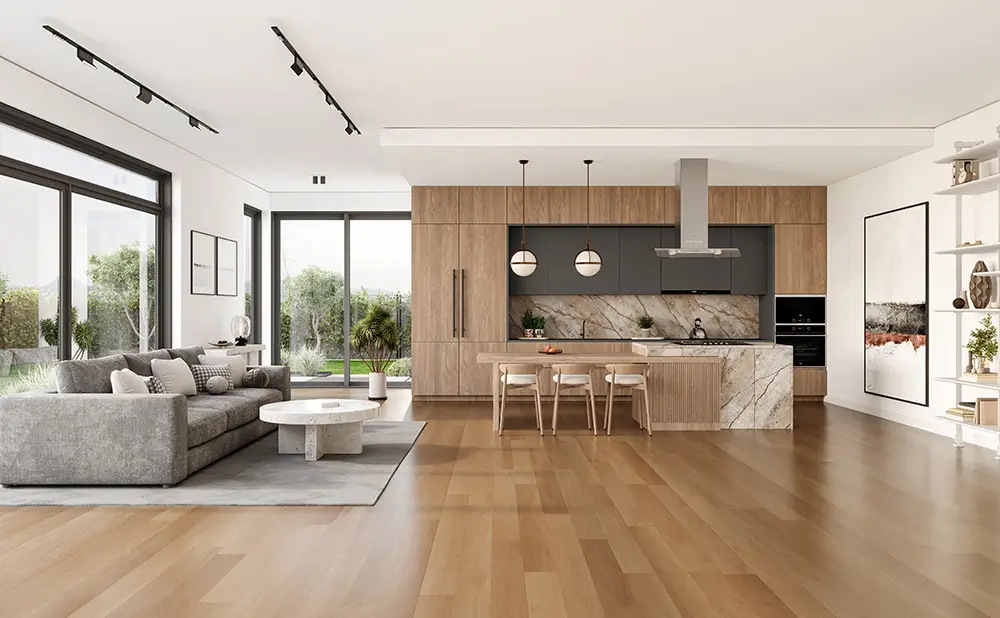
Solid and engineered hardwood look identical on a sample board. They feel identical underfoot once installed. A guest in your house will not be able to tell which one you have.
The differences are structural, and they only matter in two situations: when something goes wrong, and when you want to refinish years later.
Solid hardwood is one piece of wood, usually 3/4 inch thick. It can be sanded and refinished 4 to 6 times over its lifetime. It moves a lot with humidity, which is why it has to be nailed or stapled to a wood subfloor and given proper expansion gaps. Put it on a damp slab and it will fail.
Engineered hardwood is a real wood top layer, usually 2mm to 6mm thick, glued onto a plywood or HDF core. The core stays dimensionally stable when humidity swings. It can go on concrete, over radiant heat, in basements, and in places solid wood cannot survive. It can be refinished too, but only as many times as the wear layer allows. A 2mm layer gets you one light sanding. A 6mm layer gets you 3 or 4. (We get into specifics on species, sanding, and finishing on our hardwood floor service page if you want to go deeper on the install side.)
That’s the structural difference. Everything from there is about which one fits your house.
When I’d put solid hardwood in your house
The first thing I check is the subfloor. If you have plywood or board subfloor over a crawlspace, joists in solid shape, no recurring moisture problems below, solid is on the table. That covers most of Trinity Park, Forest Hills, Hope Valley, Hillandale, Watts-Hillandale, and the older parts of Old West Durham.
How long you’re staying matters next. If you’re going to live there 15+ years, solid wood pays you back. We’ve sanded floors in Durham bungalows that were laid in the 1940s and they’re still on their original boards, just refinished a few times along the way. A modern engineered floor with a thin wear layer cannot do that.
Solid is also the right call if you want to change stain colors later. Going from a yellow-tinted oak to a dark walnut to a natural matte over the decades is something you can do once, twice, three times on solid without replacing the floor. Thin engineered locks you into roughly the color you started with.
And if you’re matching to existing wood, solid is usually the only way to get a real visual match. Original heart pine or 2-1/4 inch white oak doesn’t have an engineered equivalent at the same width and grain. We do this kind of match-in fairly often when families add a room onto an older Durham home.
When I’d put engineered hardwood in your house
Concrete slab is the big one. Almost every house built in South Durham, Brier Creek, parts of Wake Forest, and the newer Cary subdivisions has a slab on at least the first floor. Solid hardwood directly on a slab is a callback waiting to happen. Engineered, glued or floated with a vapor barrier, does fine.
Basements are similar. Below grade always has more humidity than above grade, even with a dehumidifier running. Solid wood will move and gap. Engineered handles it.
Radiant heat is another non-negotiable. The temperature swings under a solid hardwood floor cause it to dry out and crack. Engineered is built for it, and most manufacturers explicitly warranty it for radiant systems.
Speed and disruption can also push the call toward engineered. Most engineered products come prefinished, which means no on-site sanding, no stain dry time, and no polyurethane fumes hanging in the house for a week. You can walk on the floor the day it goes down. For families with young kids or anyone who can’t move out for 5 days, that matters.
One last thing on engineered. Even in older homes with great wood subfloors, kitchens and downstairs bathrooms see enough water that engineered (or LVP) makes more sense in those rooms specifically. We’ve ripped out plenty of solid hardwood that cupped under a leaky dishwasher in a 1955 ranch. The fix would have been engineered with a vapor retarder, or skipping wood entirely in the wet rooms and keeping the solid in the rest of the house.
What this looks like in actual Durham neighborhoods
Take a 1925 Trinity Park bungalow with original 2-1/4 inch white oak, family staying long-term. Solid, site-finished, matched to the original. There’s no version of that job where engineered is the right call.
A 2018 build in Brier Creek with a concrete slab and an open kitchen-living area is the opposite. Engineered with a 4mm wear layer, glue-down, prefinished European white oak. Same look as solid, no slab problem, done in 3 days.
For something in between, like a 1960s Hope Valley split-level with a wood subfloor upstairs and a slab basement, we’ll often split it. Solid up, engineered down, picked to match in color and width so the transition reads as one floor.
Carrboro 1940s farmhouse adding 12 feet onto the kitchen? Solid, milled to match the original 3-inch heart pine, acclimated 14 days before install. That’s a job where the wrong product will be visible from across the room for the next 50 years.
A Wake Forest new build in Heritage where the family is the second owner and plans to sell in 5 to 7 years is engineered territory. Prefinished, fast install, holds up to a dog and two kids without paying for a refinishing premium they’ll never use. The American Hardwood Information Center has good background on which species and grades hold up best in high-traffic family homes if you want to read up before picking.
Cost: it’s closer than you’d expect
This is where homeowners get surprised.
Mid-grade solid oak installed in Durham in 2026 runs roughly $8 to $12 per square foot, materials and labor included. That’s site-finished or pre-finished, standard widths.
Mid-grade engineered oak with a 3mm to 4mm wear layer runs roughly $7 to $11 installed. The materials are usually a little less, the install is faster (especially prefinished glue-down), and the labor savings show up in the quote.
Once you’re shopping high-end engineered, like wide-plank European oak with a 6mm wear layer and a fancy finish, you can easily clear $15 per square foot. The cheap end of engineered, the kind sold at warehouse clubs, is usually a 1mm or 2mm wear layer that won’t survive a refinish. I avoid those for clients who plan to stay in the house.
The takeaway: pick based on subfloor and lifespan, not on which one’s cheaper. The price gap is small enough that it shouldn’t drive the decision.
How I actually walk through this with homeowners
When we come out for the free in-home estimate, the first thing we do is look at the subfloor. Pull a vent. Check a closet corner. If you have a slab, we measure for moisture. If you have a crawlspace, we look underneath. Five minutes of that tells me 80% of what you should install.
Then we talk about how long you’ll be in the house, what’s happening in the kitchen and bathrooms, whether you have pets, whether there’s a slab anywhere, and whether you want to refinish in 12 years or just live on it. From there I can usually give you a clear recommendation right then.
You can read more about how we handle hardwood flooring installation across the Triangle, including the species we work with most often and how we run a typical Durham job.
What about LVP?
In some Durham homes, the right answer for the whole first floor is luxury vinyl plank, not wood at all. Pet-heavy households, families with small kids and a lot of spills, basements, kitchens, anywhere moisture is the main enemy. We’ve covered that comparison in detail in Laminate vs. LVP for a Durham home if you want to weigh it against engineered wood.
For most upstairs bedrooms, dining rooms, living rooms, and hallways though, real wood (solid or engineered) still wins on resale value and the way it ages.
The short version, by house type
Pre-1970 house with a wood subfloor: solid hardwood is almost always the answer, with engineered or LVP swapped in for the kitchen and any downstairs bath. Post-2000 house on a slab: engineered, full stop. Solid on a slab is the call I get six months later when it starts cupping.
Mixed houses (slab on one level, wood subfloor on another) get split: engineered where the slab is, solid where the wood is, picked carefully to match in color and width so the eye doesn’t catch the transition.
Two more situations where the answer is non-negotiable. Radiant heat anywhere in the floor system: engineered, because solid will dry out and crack. Going below grade into a basement: engineered, because the humidity below grade will move solid wood around no matter what dehumidifier you run.
And one judgment call. If you’re planning to sell within 5 years, prefinished engineered is usually the smarter spend. Fast install, less disruption, looks identical to a buyer walking through. If you’re staying 15 years or more and you have a wood subfloor, solid is the better buy because the refinishing math works in your favor over time.
Ready to figure out what’s right for your house?
Call us at (919) 794-1116 or request a free quote. We come out, look at the subfloor, talk through the options, and email a written quote within a day or two. Same-day response Monday through Friday. No pressure, no obligation.
We’ve been doing this in Durham since 2009 and across the Triangle the whole time. If you’re in Chapel Hill, Cary, Raleigh, Carrboro, Hillsborough, Wake Forest, or anywhere within 30 minutes of our shop at 237 Obie Dr, we’ll come take a look.
Mario Vilchis is the owner of Vilchis Hardwood Floors, based at 237 Obie Dr in Durham, NC. He has installed and refinished hardwood floors across the Triangle since 2009, including jobs in Trinity Park, Hope Valley, Forest Hills, Hillandale, Brier Creek, Heritage, and the surrounding neighborhoods. Vilchis Hardwood Floors is fully licensed and insured in North Carolina.