
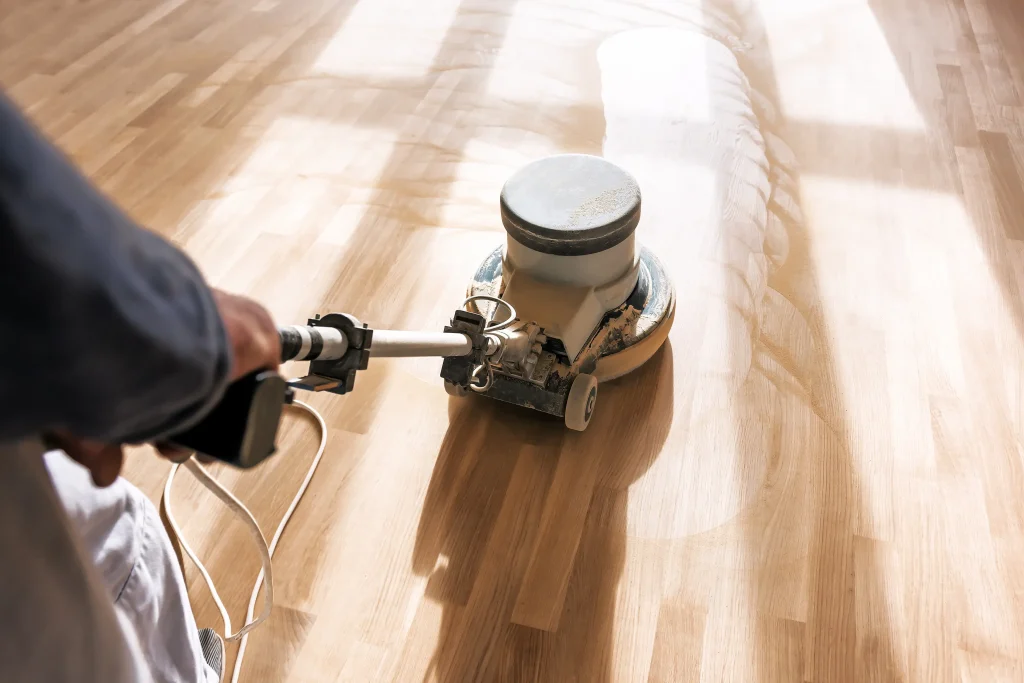
Here’s the short version, because it’s the thing everyone calls to ask: you can stay in your house. Most of our Durham refinishing customers sleep in their own beds every night of the job. The kitchen works. The upstairs bedrooms are fine. What you can’t do is walk on the floor we’re working on, and that restriction lasts longer than the sanding does.
That’s the part people get wrong. They brace for the dust and then get blindsided by the cure time.
So this is the whole job, start to finish, the way it actually goes in a Durham house. I’ve written it out the way I’d explain it standing in your living room with a moisture meter in my hand.
What “dustless” means, and what it doesn’t
Our sanders run a hose straight into a sealed containment vacuum. Dust gets pulled off the drum the moment it’s cut, before it has a chance to go anywhere. It ends up in a bag outside, not in your air ducts.
It is not dust-free. Nobody’s is. Anyone who tells you their sanding is 100% clean is either lying or has never sanded a floor. We catch somewhere around 95%, and I’ll tell you below exactly where the other 5% ends up so you’re not surprised by it.
If you want the deeper explanation of how the containment system works, I wrote that up separately in our piece on dustless refinishing and keeping a house livable during the job. This post is about the schedule.
The day before we show up
You do four things. None of them take long.
Clear the room completely. We move basic furniture as part of the job, but small stuff, lamps, books, anything on low shelves, that’s on you. Everything within about three feet of the floor picks up fine dust whether we contain it or not.
Take pictures off the walls in the work rooms. Drum sanders vibrate the framing more than you’d expect. I’ve watched a picture walk off a nail in an Old North Durham bungalow.
Pull area rugs out of the whole house, not just the work area. They’re the single worst thing to have around during a refinish, because they hold dust and then release it back into the room for weeks.
Figure out where the pets are going. This is the one people leave until the morning we arrive, and then it’s a scramble. Cats especially. A cat that walks across a wet finish coat is a problem we can’t fix without re-sanding that section.
Day one: the sand
We tape off the work area, seal the HVAC returns in those rooms, and set up the containment. Then we take the floor down past the old finish, past any stain, into fresh wood. Three passes usually, working from a coarse grit to a fine one.
This is the loud day. Not dusty, but loud. If you work from home, plan to be somewhere else between about 8 and 4, or at least on the far side of the house with the door shut. I’m not going to pretend a drum sander is background noise.
The edges get done by hand with an edger, and this is where most of the remaining dust comes from. The containment hood on an edger can’t seal against a baseboard the way the big sander seals against open floor. There’s no equipment that solves this. There’s just a guy with a vacuum working carefully.
Day two: repairs, stain, or the first coat
What happens depends on your floor.
If there are boards to replace, gaps to fill, or a burn mark near the fireplace to weave out, that work happens now, after the sanding shows us exactly what we’re dealing with. Sometimes the sand reveals something we didn’t see through eighty years of finish. That’s normal.
If you’re staining, this is stain day. One thing I say to every customer and I’ll say it here: do not pick your stain color from a phone screen. Color reads completely differently on oak in your own living room at four in the afternoon. We bring samples and put them on your actual floor. People change their minds at this step constantly, and they’re always glad they did.
If you’re going clear, we buff and lay the first coat of poly.
Days three and four: finish coats
Two coats minimum. Three if it’s a kitchen, a hallway, or the path from the garage door, and I’d push you toward three in those rooms. It adds a day and a few hundred dollars and it’s the cheapest insurance in the whole job.
Between coats we buff with a vacuum-fed machine and go over everything with a tack cloth. The buffing dust is finer than sanding dust and needs that second pass.
Water-based finish dries fast and barely smells. Oil-based gives you that warmer amber tone people want, but it’ll fill the house with fumes for a few days. Most of our Durham customers pick water-based now, and if anyone in the house has asthma, I’ll steer you there without you asking.
Cure time is the part that actually inconveniences you
Dry and cured are different things, and the difference is where people get into trouble.
Socks only, after about 24 hours from the last coat. Furniture back after three to four days, and lift it, don’t drag it. Area rugs stay off for two full weeks. Putting a rug down early traps solvent under it and you’ll get a permanent dull rectangle in your brand new finish.
Pets off the floor for the same window as the furniture. Claws in soft finish leave marks that don’t buff out.
So a typical Durham first floor, roughly 1,000 square feet with no stain change, is four days of us in the house and about two weeks before the room is fully back to normal. Add a day if you’re staining.
Where the last 5% of dust actually goes
Straight answer, since I promised one.
It settles in the work room itself, mostly along the baseboards and in the corners where the edger ran. A little bit tracks into the adjoining hallway on our boots, no matter how careful we are. If a return vent in the work room isn’t sealed well, some gets into the duct, which is why we seal them before we start rather than after.
What it does not do, and this is the whole point of the equipment, is settle on your kitchen counters two rooms away, or coat the inside of your cabinets, or come back out of your HVAC system for a month. That’s what an uncontained sand job does. Our cleaning crew can come through afterward and handle the fine film in the work area so the room’s genuinely ready when you get it back.
The lead question nobody brings up, and every Durham homeowner should
If your house was built before 1978, this matters, and most flooring contractors will not mention it.
A lot of Durham’s housing stock is well before that line. Trinity Park, Watts-Hillandale, Forest Hills, Old North Durham, the mill houses, plenty of Hope Valley. If those floors were ever painted, or if there’s old varnish and painted trim in the sanding zone, lead is a live possibility. Sanding is exactly the activity that turns a stable painted surface into airborne dust.
The EPA’s Renovation, Repair and Painting Rule covers this. Any firm paid to do work that disturbs paint in a pre-1978 home has to be certified, and the rule spells out containment and cleanup requirements. The EPA’s own page for contractors lays out who needs certification and what work is covered. It’s worth ten minutes of your time if your house is old.
Here’s the practical version: ask any refinisher you’re considering whether they’re EPA Lead-Safe certified, and ask them to show you the firm certification. Not a verbal yes. The certificate. A contractor who gets cagey about that question in a 1940s house is telling you something.
Containment sanding helps here for the same reason it helps with wood dust, it captures material at the source instead of letting it disperse. But the certification is a separate thing from the equipment, and you want both.
If you’re in one of those older houses, the other thing worth reading before you start is what we typically find under the floors in 1940s Durham bungalows, because subfloor surprises change timelines more than anything else on this list.
What a bad refinish looks like six months later
You’ll see swirl marks under raking light from a window, usually from a floor buffer used wrong. You’ll see drum stop marks, dark curved lines where a sander sat still for half a second too long. You’ll see the finish wearing through in a traffic path way before it should, which almost always means two thin coats instead of three proper ones.
None of that shows on the day the crew leaves. That’s the problem with judging a floor job on handover day.
The other tell is price. If a Durham refinishing quote comes in dramatically under everyone else’s, ask what equipment they’re sanding with and how many coats are included. That’s usually where the savings live. I broke down the real numbers in what it costs to refinish hardwood floors in Durham, and the honest range is $3 to $5 a square foot.
Frequently asked questions
Is dustless sanding really dust-free? No. It captures roughly 95% of sanding dust at the source. There’s still a light film in the work room, mostly along the edges and baseboards. The rest of your house stays close to normal, which is the actual benefit.
Can I live in my house during a refinish in Durham? Most of our customers do. With water-based finish there’s very little odor. With oil-based, plenty of people leave for two or three nights. If someone in the house has asthma or a chemical sensitivity, tell us at the estimate and we’ll give you a straight answer about your specific situation.
How long does dustless refinishing take? Four days for a typical 1,000 square foot Durham first floor with no stain change, five if you’re staining. Then roughly two weeks of cure time before rugs and full normal use.
Does dustless sanding cost more? A little. The containment setup takes longer to run than an open-bag sander. It’s built into our $3 to $5 per square foot range rather than billed separately.
When can I put my furniture back? Three to four days after the final coat. Lift it into place, don’t slide it. Area rugs wait two full weeks.
Do I need to be home while you work? No. Plenty of our customers give us a key and go to work. Someone should be reachable by phone, because if we find something under the finish that changes the job, I want to talk to you before we keep going.
Do you refinish floors outside Durham? Yes. Chapel Hill, Carrboro, Hillsborough, Cary, Apex, Morrisville, Raleigh, Garner, and Wake Forest are all regular territory. Most of our jobs are within a 30-minute drive of the shop.
Getting a real number for your floor
I don’t quote refinishing over the phone. The phone can’t see whether your subfloor is solid, whether the last refinish left burn marks, or whether there’s enough wood above the tongue to sand again. Those three things decide the price.
Call the shop at (919) 794-1116 or ask for a free in-home estimate. I come out, look at the floor, and email you a written fixed-price quote within a day or two. No charge, no obligation, and nobody’s going to lean on you to sign anything that afternoon.
You can also read more about our hardwood floor installation and refinishing services.
Vilchis Hardwood Floors 237 Obie Dr, Durham, NC 27713 (919) 794-1116 Monday to Friday, 9:00 AM to 5:00 PM
Mario Vilchis runs Vilchis Hardwood Floors out of 237 Obie Dr in Durham. He’s been installing and refinishing wood floors across the Triangle since 2009, is licensed and insured in North Carolina, and shows up to every estimate himself.