
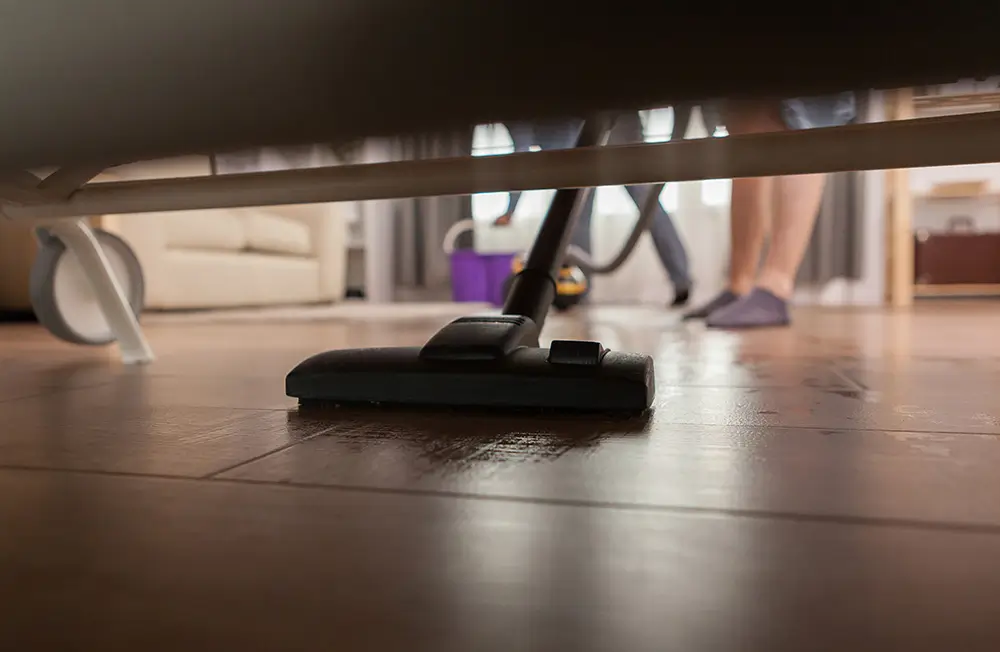
Every month we get calls from people whose hardwood looks tired, hazy, or gray in the walkways after only a few years, and most of them assume they need a refinish. Some do. A lot of them need hardwood deep cleaning first, because the dullness they’re seeing is dirt and old cleaning product sitting on top of a finish that’s still in decent shape. Mopping won’t get that off. A professional deep clean usually will, and it costs a lot less than sanding.
What Your Mop Leaves Behind
A microfiber mop and a pH-neutral cleaner are the right tools for weekly cleaning, and I’d never tell anyone to stop. The trouble is that a mop only gets the top layer. Fine grit works its way into the texture of the finish, into the seams between boards, and into the little beveled edges on a lot of prefinished floors, and a damp pad slides right over it. Over a few years that grime builds up and the floor reads darker and duller than it really is.
Then there’s what people put on the floor trying to help. Oil soap leaves a residue that builds up. The mop-and-shine and “restore your shine” products leave a film that looks fine for a week and then turns cloudy. Vinegar is acidic and slowly dulls a polyurethane finish. And steam mops push moisture down into the seams, which shows up later as cupping and cloudy spots. The National Wood Flooring Association’s maintenance guidance says flat out not to use wet mops or steam mops on wood, because over time they damage the finish and the wood both. If your floor looks dull the same afternoon you mopped it, residue is usually the reason.
What A Professional Deep Clean Does
A deep clean starts the same way your weekly routine does, with getting the loose dirt and grit off. After that, a cleaning machine, usually with scrubbing brushes or pads, works a wood-floor cleaner into the surface using very little water, gets down into the texture and the seams, and picks the dirty solution back up so it doesn’t dry back onto the floor. A mop can’t do that last part.
On a floor with an intact finish, that takes off the ground-in grime, the sticky film around the kitchen and the back door, and a lot of the haze from old products. Heavy buildup from years of polish is tougher. Sometimes it needs a stronger stripping step, and sometimes it’s easier to deal with during a refinish. We’ve had jobs where we had to do extra sanding just to get through the shine product someone had been putting down.
Restoring a floor that’s gone dull or hazy is something we handle through our cleaning services. I’d rather you call us than rent a machine from the hardware store and hope, because too much water or the wrong pad on the wrong finish can do more harm than the dirt was doing.
What A Deep Clean Can’t Fix
A deep clean only reaches what’s sitting on top of the finish, so scratches that cut into the finish are still there afterward, just cleaner. Where a traffic path has worn through to bare wood, the gray stays, since there’s no finish left there to clean. And cleaning does nothing for dark stains that went into the wood, like pet urine or water from a leaky dishwasher. Our posts on pet urine stains and water-damaged floors cover those.
Clean, Recoat, Or Refinish?
I’ve had homeowners apologize for how bad their floors look, sure they’re beyond help, when the floor really just needed a good cleaning or a recoat. If the finish is still there and the floor looks dirty, dull, or hazy, a deep clean is the place to start.
Light scratches all over a room are different. At that point you don’t really have a scratch problem, you have a worn finish, and that’s what a screen-and-recoat is for. We scuff the old finish and put a fresh coat over the top, and the NWFA guidance I linked above describes recoating as the way to renew a floor that’s starting to look dull. Our post on getting scratches out of hardwood goes through where that line is. Wear that’s gone through to the wood across the room, or real damage, means a full sand and refinish, and our Durham refinishing cost guide covers what that runs.
Cleaning and recoating also go together. A new coat of finish has to bond to the old one, and the film from shine products keeps it from bonding. So a floor that’s getting a recoat has to be clean first, and a deep clean is often the first step.
Wax And Oil Finishes Are A Different Animal
Everything above is about polyurethane, which is what’s on most floors put down in the last few decades. Plenty of the original floors in older Durham bungalows and mill houses have a wax or penetrating-oil finish instead, and those don’t want a wet clean of any kind. Water spots them, and regular hardwood cleaners can haze them. They need paste wax and buffing. If you’re not sure what’s on your floor, find out before anyone cleans it, and our post on how to clean hardwood floors explains the difference.
Keeping It Clean Between Deep Cleans
The day-to-day stuff is what keeps you from needing a deep clean very often. Get the grit off a few times a week with a microfiber dust mop, or a vacuum on the bare-floor setting with the beater bar off. Damp-mop with a pH-neutral hardwood cleaner on a pad that’s barely wet. Keep vinegar, ammonia, oil soap, all-purpose cleaners, and steam mops off the floor for good. Mats at the outside doors and felt pads under the furniture do more than people expect. Our daily, weekly, and seasonal care routine lays out the whole schedule.
How often you’ll need a deep clean depends on the house. A couple with no pets and shoes off at the door can go a long time. A family with two dogs and a back door that opens onto red clay will need one sooner. The sign is the one I mentioned earlier: the floor looks dull right after you mop it.
Getting Your Floors Looked At
If you’re not sure whether your floor needs cleaning, a recoat, or a refinish, I’ll tell you on a free visit, and I won’t talk you into sanding a floor that doesn’t need it. We’re a flooring and cleaning company in Durham, so we can handle whichever one it turns out to be. You get a written, fixed quote by email, usually within a day or two, and our hardwood flooring page has more on recoating and refinishing.
Vilchis Hardwood Floors
237 Obie Dr, Durham, NC 27713
(919) 794-1116
[email protected]
Monday through Friday, 9:00 AM to 5:00 PM
Serving Durham, Raleigh, Cary, Chapel Hill, Carrboro, Hillsborough, Apex, Morrisville, Garner, and Wake Forest.
Request a free in-home estimate
Frequently Asked Questions
Will A Deep Clean Remove Scratches?
No. It cleans what’s on top of the finish. Scratches in the finish need a recoat, and scratches into the wood need sanding.
What’s The Difference Between A Deep Clean And A Recoat?
A deep clean takes dirt and residue off the existing finish. A recoat adds a new layer of finish on top. A dull floor with an intact finish may only need the cleaning. A floor with a worn finish needs the recoat, and it usually gets cleaned first so the new coat bonds.
Can I Rent A Machine And Do It Myself?
You can, but I wouldn’t. Too much water or the wrong pad can damage the finish you’re trying to clean, and if your floor has a wax finish, a wet clean can make it worse.
Will A Deep Clean Fix Gray Traffic Paths?
Only if the gray is dirt. If the finish has worn through to bare wood, cleaning won’t bring it back, and that floor needs a recoat or a refinish.
Mario Vilchis runs Vilchis Hardwood Floors out of 237 Obie Dr in Durham. He’s been installing and refinishing wood floors in the Triangle since 2009 and shows up to every estimate himself. Reach the shop at (919) 794-1116.