
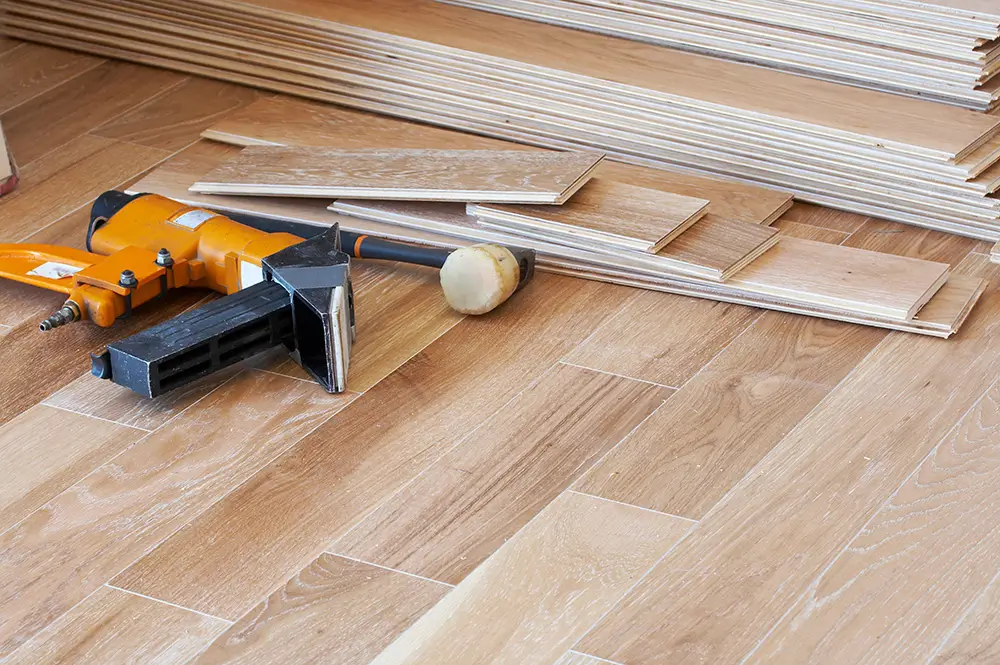
An aluminum oxide factory finish is hard enough that a standard sanding screen barely scuffs it. A new coat needs a scuffed surface to grip, so on these floors an ordinary screen and recoat can peel or flake later. Prefinished floors can be recoated, but the prep has to be made for factory finishes. That means a deep clean, then a bonding agent or a more aggressive abrasion step, whichever the finish maker specifies, and a test patch before the whole floor gets coated. If the wear has gone into the wood, or you want a new color, the floor needs a full sand, and the factory bevels make that a bigger job than it is on a site-finished floor.
What an aluminum oxide finish is
Prefinished boards arrive already sanded, stained and sealed. The coating goes on in the factory, usually as several coats of urethane cured under ultraviolet light, with aluminum oxide particles mixed in. Aluminum oxide is the same mineral used as the grit on a lot of sandpaper. It’s the reason prefinished floors hold up to years of foot traffic, and part of why manufacturers back the finish with long warranties.
In Durham you’ll find these floors all over the newer subdivisions. A lot of houses around South Durham were built on concrete slabs, and the wood that goes over a slab is usually engineered, which usually comes prefinished. Our post on hardwood laid directly over a concrete slab explains why solid boards don’t belong there, and how engineered boards are built covers the layers underneath that factory coat.
Why a normal recoat fails on it
The finish is harder than the screen
A screen and recoat works on a site-finished floor because a buffer with a fine sanding screen roughs up the old polyurethane in a single pass or two. On aluminum oxide, a worn or fine screen glides over most of the floor and only scuffs the high spots. That leaves a patchwork, with some areas ready to bond and others still slick. Switch to a coarser screen to get through it, and you can cut swirl marks into the finish that show through the new coat, especially if that coat is shiny.
New finish laid over a surface that wasn’t evenly scuffed can look fine at first and start lifting later. Then the loose finish has to come off before anything else can go on.
Bevels and textured boards
Most prefinished boards have a small V-groove along each edge. A buffer rides over those grooves without touching the bottom of them, and wire-brushed or hand-scraped surfaces have the same problem across the whole face of the board. Grime and old cleaning residue collect in those low spots too. The bevels cause trouble for full sanding as well, which our post on taking a prefinished floor lighter gets into.
Whatever has been cleaning the floor
Oil soap, mop-and-shine products and polishes leave a film, and new finish won’t bond to the film any better than it bonds to slick aluminum oxide. Steam mops add their own damage. A floor that has been cleaned with the manufacturer’s recommended cleaner is far easier to recoat than one with years of shine product on it.
Check the warranty before anyone touches it
Find out who made the floor and which product line it is. The label on a leftover box in the garage or attic is the easiest place to look. The builder’s paperwork or the receipts from whoever installed it will also have it. Then read that manufacturer’s care guide and finish warranty, or call them.
Manufacturers don’t all treat recoating the same way. AHF Products, which makes Bruce and other brands, says in its technical bulletin on recoating factory-finished floors that a recoat done to industry standards and the finish maker’s instructions generally doesn’t hurt its finish warranty, while sanding down to bare wood ends that warranty because the factory finish is gone. Other manufacturers are stricter, and some treat any added coat as the end of the finish warranty. Know which one you have before you decide.
What works
A deep clean first
Every recoat on a prefinished floor starts with getting the residue off, including the grime packed into the bevels. That’s a job for a cleaning machine and a cleaner made for wood floors, and our post on machine cleaning versus a mop explains what that removes. If there’s heavy polish buildup, it has to come off completely, or nothing put on top of it will last.
Prep made for factory finishes
Finish manufacturers sell recoat systems made for aluminum oxide and other factory finishes. Depending on the system, the prep is a strong cleaner, an abrasive pad, a chemical bonding agent, or some combination. The bonding agent does chemically what the screen does on a site-finished floor, and some of these systems skip abrasion entirely, which is how beveled, wire-brushed and hand-scraped floors get recoated. The flooring manufacturer will often name the systems it approves, and following its instructions is also how you keep the finish warranty intact where the manufacturer allows a recoat.
A test patch before the whole floor
Before coating a whole room, coat a small area in a spot that gets normal foot traffic and let it cure. Then score a small crosshatch through the new coat with a utility knife, press a strip of tape over it and pull it off fast. If the new finish stays put, it bonded. If flakes of it come up on the tape, the prep needs another look before anything else gets coated.
A lower sheen
Even with the right prep, a prefinished floor that gets abraded can end up with faint marks in the old finish. A matte or satin top coat hides them much better than semi-gloss does, and only the last coat decides the sheen. Our post on how sheen changes the scratches you notice has more on that.
A recoat is usually about a day of work, plus a few days of cure before the furniture goes back.
When it needs more than a recoat
A recoat only renews the finish. Scratches you can catch a fingernail in, dents, gray paths where the factory finish has worn through, and peeling from an earlier bad recoat are all beyond what a new coat can fix.
If the damage is limited to a handful of boards, replacing those boards is often the better repair. Spot touch-ups are hard to blend on a factory finish, which is why touch-up options for small scratches work better on site-finished floors. Leftover boxes from the original install come in handy here, because a board from the same product line matches far better than anything bought years later.
A full sand is possible on solid prefinished floors and on engineered floors with enough wood left, but it’s a different job from sanding a site-finished floor. The sander has to cut below the bottom of the bevels, or the grooves stay visible, and that takes off a lot of wood. Aluminum oxide also dulls sandpaper fast, so the sanding takes more paper and more time. On engineered boards, the wear layer decides whether you can sand at all. The NWFA’s certification for refinishable engineered flooring requires at least 2.5 mm of wood on factory-finished smooth boards. Thinner wear layers may only ever take recoats, and when those are used up, the floor gets replaced.
After a full sand, the floor is site finished from then on, with no bevel grooves if the sanding went deep enough, and any factory finish warranty is over. The full-sand pricing for Durham homes gives you a starting range, and a prefinished floor will land toward the higher end because of the extra sanding. If you’re choosing a new floor right now, our post on the trade-offs of factory-finished boards explains when site-finished is the better pick.
Keeping a prefinished floor recoatable
The best time to recoat a prefinished floor is before it looks bad, while the factory finish is still intact everywhere. Clean it with the product the manufacturer recommends, and keep oil soap, shine products, wax and steam mops off it for good. Put felt pads under the furniture and a mat at every outside door, since red clay grit wears a finish down faster than almost anything else. Our weekly and seasonal upkeep checklist for Triangle homeowners covers the rest.
Frequently asked questions
Can you screen and recoat a prefinished floor?
Yes, with the right prep. A standard screen and recoat alone often doesn’t bond to aluminum oxide. A deep clean followed by a recoat system made for factory finishes, plus a tape test on a small area, gives the new coat something to hold on to.
How do I know if my floor has an aluminum oxide finish?
Most prefinished hardwood sold over the last few decades uses one. Small V-grooves along the board edges are a good sign the floor is prefinished. The manufacturer’s name and product line, from a leftover box or your paperwork, will tell you exactly which finish it has.
Will recoating void my prefinished floor’s warranty?
It depends on the manufacturer. Some allow a recoat done to industry standards with an approved system, and others void the finish warranty once any coat is added. Sanding to bare wood ends a factory finish warranty in every case, because the factory finish is gone.
Can prefinished hardwood be sanded and refinished?
Solid prefinished floors can. Engineered floors can if the wear layer is thick enough. Either way, the bevels mean more sanding than a site-finished floor needs, so expect it to cost more.
How long does recoating a prefinished floor take?
About a day of work for most homes, plus a few days of cure before furniture goes back. Stick to socks for the first 24 hours.
Prefinished floor looking tired?
We work on prefinished and site-finished floors across Durham, from the newer neighborhoods in South Durham and around Southpoint to Woodcroft, Hope Valley and Trinity Park, and in Chapel Hill, Carrboro, Raleigh, Cary and Wake Forest too. Bring the product name if you have it. We’ll look at the finish, check whether it will take a recoat, and send you a written quote, usually within a day or two. See our Durham hardwood refinishing and repair work, browse before-and-after photos from local jobs, or set up a free floor assessment.
Vilchis Hardwood Floors 237 Obie Dr, Durham, NC 27713 (919) 794-1116 · [email protected] Monday to Friday, 9 a.m. to 5 p.m.
Written by Mario Vilchis, owner of Vilchis Hardwood Floors, a Durham flooring contractor since 2009 that installs and refinishes floors across the Triangle. Mario comes out to every estimate personally.