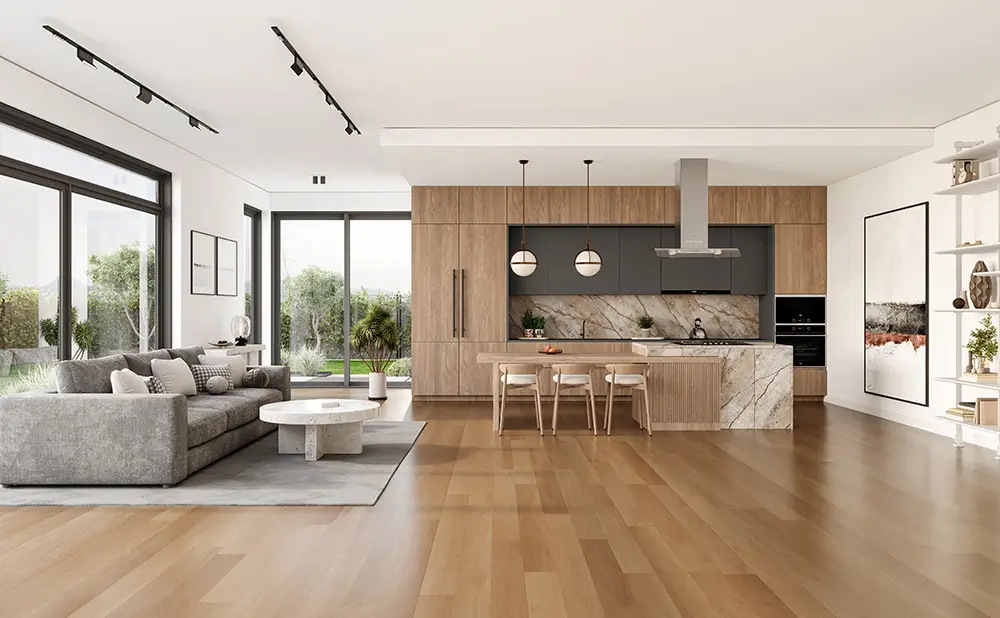

Short version: most of the laminate we install in Durham lasts 15 to 25 years. But that range is wide for a reason, and the honest answer is “it depends on three things.” We’ve torn out floors that were shot in five or six years, and we’ve walked into houses with early-2000s laminate that’s still doing fine. What separates the two isn’t luck. It’s the product, the install, and how the floor gets treated once we leave.
Here’s what we’ve learned from doing this in real Durham houses for 16 years.
What the end of a laminate floor looks like
A laminate floor doesn’t usually die all at once. It wears out in one of two ways.
The first is the wear layer. That clear top coat takes the abuse, and over years of foot traffic and grit it slowly dulls and thins until the printed photo underneath starts to show through. Manufacturer warranties on that wear layer run 15 to 30 years, but here’s the part the warranty won’t tell you: the floor usually looks tired well before it technically “fails.” Shiny traffic paths in the hallway, dull patches in front of the couch. That’s the floor telling you it’s getting old.
The second way is moisture, and this is the one that ends a floor early. Laminate has a fiberboard core, and once that core swells from water it doesn’t go back. You can’t sand it, you can’t refinish it. When a laminate floor is water-damaged, it’s done. That’s the single biggest difference between a laminate floor that sees 20 years and one that’s ripped out at year six.
What kills laminate early in Durham
Almost every prematurely dead floor we pull up failed for the same handful of reasons, and most of them trace back to our climate or a rushed install.
Moisture from below is the top one. A lot of Durham homes sit over crawl spaces, and older houses often have a slab or subfloor that was never sealed against ground moisture. That damp creeps up into the back of the planks for years until the core gives out. Pair that with our humid summers and you’ve got the perfect setup for swelling and lifting seams.
No expansion gap is a close second. A floating floor has to have room to move when it swells in June. Skip that gap at the walls and the boards push into each other until they peak in the middle of the room. We get called to fix this constantly, and it’s almost always a DIY job or a crew that rushed.
After that it’s the cheap stuff: a thin, low-density core and a low wear rating dropped into a busy room. The abrasion rating on laminate runs on an AC scale, but that number is only one piece of how durable a floor really is. As the North American Laminate Flooring Association explains in its durability white paper, impact and stain resistance matter too, and a high AC number alone won’t save a floor that’s installed over a wet subfloor. Put a budget plank in a hallway with two dogs and you’ll see it age in a few years.
What makes it last the full 20
The floors that go the distance have a few things in common, and none of them are complicated.
They start with a decent product matched to the room. For a busy Durham house we won’t drop below an AC4 wear rating, and we’ll often spec a water-resistant core given our humidity. It costs a little more and it buys you years.
They get installed right. This is the part that decides everything. The laminate gets acclimated to your home before it goes down, the subfloor gets checked for moisture and leveled, a real moisture-barrier underlayment goes under it, and the expansion gaps get left and hidden under the baseboard. We walk through our whole laminate flooring installation process if you want the detail, but the takeaway is simple: the boring prep work is what gets you to year 20.
And they get reasonable care. Sweep or vacuum the grit, damp mop instead of wet mopping, keep felt pads on the furniture, and wipe up spills before they sit. None of it is hard, and it’s the difference between a floor that looks new at year ten and one that looks beat.
What we see in the field
We installed laminate a couple of years back for a family in north Durham with three labs and a toddler — about as hard a test as a floor gets. We checked back two years later and it still looked new, because it was a good product put down over a properly prepped subfloor. That’s the pattern. When the product, the prep, and the care all line up, laminate quietly does its job for two decades.
When one of those three is missing, the clock speeds up. The same plank that lasts 20 years in a dry, climate-controlled living room might last six over a damp crawl space with no underlayment. The floor isn’t the only variable, and it’s usually not the one that fails first.
Laminate vs. hardwood if you’re thinking long term
This is worth being straight about. Laminate’s ceiling is roughly 25 years, and when it’s done you replace it. Hardwood plays a different game — a solid hardwood floor can last 50 years or more because you can sand and refinish it several times over its life. If you’re planning to stay in your house for decades and want a floor you’ll never fully replace, hardwood is the longer-game investment.
That said, laminate isn’t trying to be hardwood. It’s trying to give you a great-looking, tough floor for about half the cost, and for a lot of Durham homes, whether it’s a rental, a busy family room, or a house being prepped to sell, that math wins. We install both, so we’ll tell you honestly which one fits what you’re trying to do.
How to tell when it’s time to replace
A few signs mean the floor is near the end, and catching them early can save your subfloor:
- Soft or spongy spots underfoot, which usually means moisture in the core.
- Edges lifting or seams that have separated and won’t click back.
- Gaps that stay open even in humid weather.
- Worn, shiny traffic paths where the finish is gone.
- Water staining or a musty smell, which can point to a problem under the floor, not just on it.
If you’re seeing any of these, give us a call before it spreads. Sometimes it’s a small section we can swap; sometimes it’s time for a new floor. We’ll tell you which.
If you’ve been searching “laminate flooring Durham NC” or wondering whether your current floor has years left or is on its way out, call us at (919) 794-1116. Estimates are free, the quote is in writing, and we’ll give you a straight answer either way.