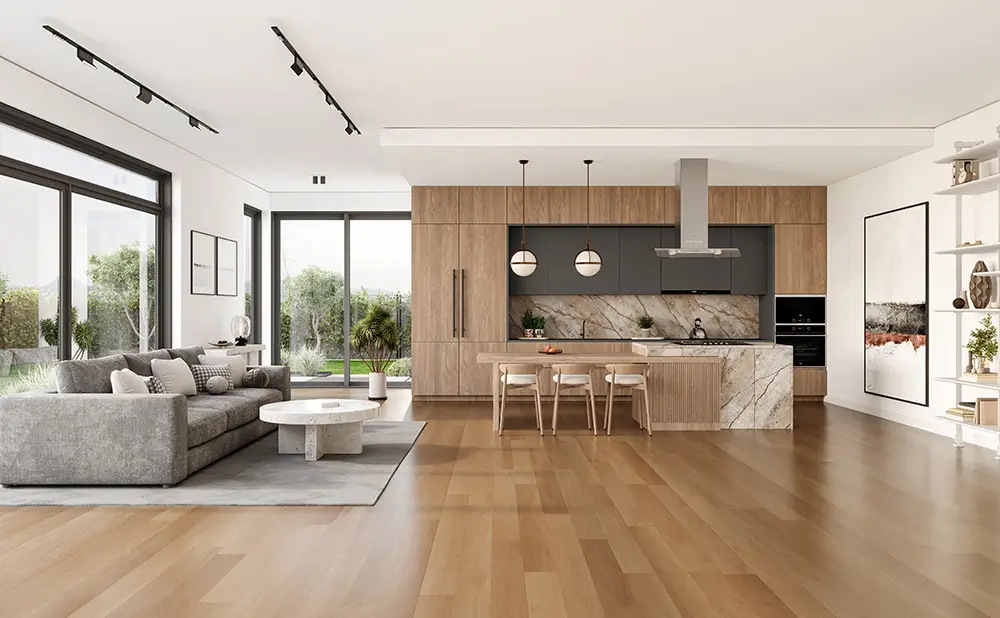

Drive through Trinity Park, Old North Durham, Watts-Hillandale, or Forest Hills and you’re looking at houses built mostly between the 1910s and the 1950s. Bungalows, four-squares, brick ranches, the occasional Tudor. Almost all of them still have original hardwood somewhere underneath whatever’s been laid on top over the decades.
When the homeowner pulls up the carpet and decides to put hardwood back, they’re usually choosing between two paths. Prefinished hardwood shows up at the house already sanded, stained, and sealed at the factory. Site-finished hardwood is raw boards that get installed first and then sanded, stained, and finished in the home.
For most of these older Durham houses, site-finished is the better call. We’re going to explain why, because the answer isn’t obvious and a lot of the marketing pushes people the other direction.
The subfloor problem nobody talks about
A 1925 Durham bungalow doesn’t have a flat subfloor. It has a subfloor that was flat in 1925. After 100 years of joist settling, plumbing repairs, the occasional foundation movement, and a few rounds of patching by various contractors, what’s down there is not level. Sometimes it isn’t even close.
Prefinished hardwood comes from the factory with finished surfaces and pre-cut bevels along every plank edge. Those bevels exist for a reason. They hide the fact that the boards can’t be sanded flat after installation, because doing so would cut through the factory finish. If your subfloor has a quarter-inch hump in the middle of the living room, prefinished boards installed over it will follow that hump. You’ll feel it underfoot. You’ll see it when the afternoon light hits the floor at a low angle.
Site-finished work handles this differently. The unfinished boards get nailed down, and then the whole floor is sanded flat as one continuous surface. Minor subfloor variations get leveled out by the sanding pass itself. Boards that sit a hair high get cut down to match the boards around them. You end up with one flat floor instead of a sequence of beveled planks tracing the topography of a century-old subfloor.
Matching existing floors is almost impossible with prefinished
This matters more in Durham than in most places, because of how these houses get renovated. Somebody buys a Watts-Hillandale bungalow with beautiful original red oak in the front rooms and ratty linoleum in the kitchen. They want to extend the original floors into the kitchen so it all reads as one space.
With prefinished, you’re hunting for a current product that matches red oak installed in 1928, stained at some point over the decades, and aged under varying amounts of sunlight for nearly a hundred years. You won’t find a factory color that lands right. The board widths probably won’t match either, and the grain pattern is going to look different. You’re going to see the seam from across the room.
Site-finished work is how you actually pull this off. Raw boards go into the kitchen, get sanded together with the existing floor (or just the new section, depending on the job), then custom-stained to match the aged tone of the original. There’s a Hardwood Floors Magazine piece from NWFA where several installers walk through how they do it, including water-popping to deepen the color and tinting the finish to bridge the gap. None of that is available to you with prefinished.
The bevel problem in older homes specifically
Bevels collect debris. In a new construction home with central HVAC pushing filtered air around constantly, this is mostly a non-issue. In a 1940s Durham bungalow with original plaster walls, gaps around old window frames, the occasional air leak, and a basement that breathes more than it should, you get more dust in the air. Grit settles into the bevels and stays there.
Over five or ten years those bevels turn into dark lines around every plank. Vacuums don’t reach into them properly, and mops just push moisture around the edges. People who chose prefinished often end up frustrated with how their floor looks compared to a neighbor’s site-finished install, and the difference usually isn’t the wood. It’s the bevels.
Site-finished floors are sanded smooth across the seams. The grit has nowhere to collect. The floor cleans like a single surface because that’s effectively what it is.
Refinishing later is easier than people think
A common argument for prefinished is that the factory finish is more durable than what you can apply on site. That’s true in the short term. Factory-applied aluminum oxide finishes are genuinely hard.
But here’s what gets left out of the comparison: refinishing a site-finished floor in 15 years is a standard job. You sand it back to bare wood, apply new stain if you want a different color, and put fresh finish on. Refinishing a prefinished floor requires sanding through the factory finish and the bevels, which means cutting deeper than a site-finished refinish would, and you end up with a floor that doesn’t match what you originally bought because the bevels are now gone.
In Durham’s older homes, original floors have often been refinished two or three times across the last century. That history matters. Site-finishing is what makes the next refinish easy. Prefinished isn’t really designed around that.
When prefinished actually makes sense
We’re not against prefinished. It’s the right call for some jobs.
If you’re flipping a Durham rental and need the floor walkable by next weekend, prefinished is faster. No sanding dust, no curing time before the furniture comes back. If you’re installing in a condo where you can’t run sanders without an HOA conversation, prefinished avoids that. If the room you’re flooring has no existing hardwood to match and the subfloor is reasonably flat, prefinished can save you money and time without much downside.
For somebody who’s owned a 1930s bungalow in Trinity Park for fifteen years and wants the floor done right because they plan to be there another twenty, though, site-finished is almost always the better answer.
What this looks like in practice
When we walk an older Durham home for an estimate, we check the subfloor first. We sight down the existing boards for cupping, gapping, and finish wear. We look at how light hits the floor at different times of day, because that tells us what bevels would look like if we used prefinished. And we talk to the homeowner about how long they plan to stay in the house, and what other rooms they might want to flow into down the road.
If the answer is “this is our forever house and we want it to look like it belongs,” we recommend site-finished hardwood almost every time. If the answer is “we just need a floor that looks decent and gets installed fast,” we’ll lay out both options and let the numbers decide.
Vilchis Hardwood Floors is run by Mario Vilchis, and we’re a family operation in Durham. A meaningful chunk of our work is in homes built before 1960. If you’ve got an older Durham home and you’re trying to decide between prefinished and site-finished, give us a call. We’ll come look at the floor in front of you and tell you what we’d actually do if it were our house.